Membrane Keypad selection is a technical decision, not just a price comparison. A keypad must fit its enclosure, withstand the cleaning agents and operating conditions it will face, and provide reliable feedback through repeated use. Grand View Research’s Membrane Switch Market report examines demand by product type, application, and region—useful context for buyers comparing materials, manufacturing capabilities, and supplier coverage. Market reports show broad trends, but they cannot confirm whether a specific factory can meet your drawing, tolerances, or quality requirements.
The interface matters. Don Norman, a design researcher and human-factors expert, wrote: “Good design is actually a lot harder to notice than poor design.” His observation applies to keypads, where clear legends, consistent key response, and thoughtful sealing can make everyday operation feel effortless. It is a design principle, not a membrane-keypad industry quotation.
This guide to 2026 manufacturers focuses on practical checks: engineering support, sample evaluation, customization, production consistency, and communication across regions. Ask for material specifications and test evidence. Inspect a sample under real operating conditions. Small details matter: a raised graphic, a connector position, or a seal that does not match the enclosure can affect the finished product. A direct quotation from a membrane-keypad specialist should be added only when its source and wording can be verified; inventing one would mislead buyers.
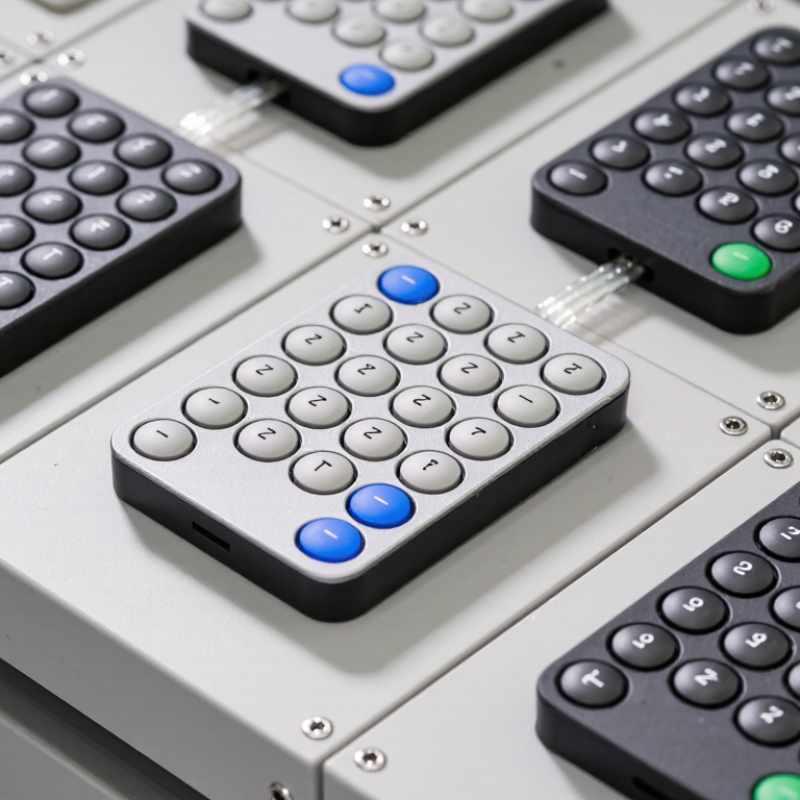
A membrane keypad is a thin control panel built from functional layers. A printed polyester or polycarbonate overlay carries symbols and protects the surface. Beneath it, a spacer separates the overlay from a circuit layer, where conductive traces register each press. A rear adhesive secures the assembly to the device. Optional metal domes add a noticeable click; LEDs provide backlighting. Small details matter.
These layers support sealed, low-profile controls for factory equipment, medical devices, appliances, and vehicle interiors. The surface can resist dust and splashes when its materials and seals are properly specified, though performance depends on the complete assembly. Grand View Research estimated the global membrane switch market at USD 4.42 billion in 2023 and forecast a 10.1% compound annual growth rate through 2030. That report covers membrane switches broadly, not keypads alone, so the figure is useful market context rather than a keypad sales estimate.
For buyers, the artwork is only part of the specification. Ask about actuation force, expected press cycles, temperature range, cleaning exposure, and connector type. A keypad that looks right may feel wrong through gloves. Still, trade-offs remain. More layers can improve shielding or tactile response, but may increase thickness and cost. I have seen simple layouts hide difficult choices: tiny legends, bright lighting, and long service life do not always fit neatly together.
Evaluating membrane keypad manufacturers in 2026 starts with the device, not a catalog. Share the operating environment, expected key life, mounting space, and interface requirements. A keypad used beside machinery may need different sealing and materials from one on a handheld instrument. Specific requirements make supplier responses easier to compare.
Request prototypes using the intended overlay, adhesive, circuit layers, and tail connector. Check key spacing, legends, tactile response, and fit against the actual enclosure. A sample that feels right on a desk may behave differently after installation. Ask how the manufacturer tests actuation force, electrical continuity, and resistance to moisture or cleaning agents. Get the test method and acceptance criteria in writing.
Look for documented inspection steps, material traceability, and clear change control. Ask what happens when a film, ink, or component becomes unavailable. These details matter during repeat orders. Compare quoted lead times with tooling schedules and sample approval stages, not just production estimates. One lesson is easy to miss: a polished prototype can conceal a weak process. Request evidence from routine production, such as inspection records or a sample report. Not every supplier will provide perfect answers. Notice how carefully they explain the gaps.
Use this non-company-specific scorecard to compare suppliers. Suggested weights total 100 points; adjust them to suit the product, market, and operating environment. Score each criterion from 0 to 5, then calculate the weighted score as: criterion weight × score ÷ 5.
| Evaluation dimension | Suggested weight | What to evaluate | Evidence to request | Buyer check |
|---|---|---|---|---|
| Design and customization | 15% | Ability to engineer overlays, graphic layers, circuit construction, tail exits, connectors, embossing, and adhesive selection to the product requirements. | Design review records, drawings, material recommendations, and a prototype made to the buyer’s specifications. | Confirm the supplier can review stack-up, tolerances, mounting method, and interface requirements before production. |
| Electrical performance | 15% | Circuit continuity, contact resistance, insulation resistance, dielectric withstand where required, and compatibility with the intended controller. | Electrical test plan and sample results against buyer-defined acceptance limits. | Check the test conditions and limits against the actual circuit design; do not assume one set of limits suits every keypad. |
| Environmental durability | 15% | Suitability for the specified temperature, humidity, cleaning agents, UV exposure, and expected actuation life. | Application-relevant test reports. IEC 60068 includes environmental test methods; the appropriate methods and severities depend on the use case. | Specify operating and storage conditions, test duration, sample count, and pass/fail criteria before qualification. |
| Ingress protection and sealing | 10% | Whether the keypad assembly and its installed interface meet the required protection against solid objects and water. | Test documentation for the complete relevant assembly. IEC 60529 defines IP-code classification for enclosures. | Verify what was tested, including mounting surface, gasket, adhesive, tail exit, and enclosure; a component claim alone may not represent the installed product. |
| Materials and regulatory documentation | 10% | Traceability and suitability of films, inks, adhesives, and other specified materials, including documentation needed for target markets. | Material declarations and applicable compliance documents. RoHS (Directive 2011/65/EU, as amended) and REACH (Regulation (EC) No 1907/2006) may be relevant depending on product and market. | Check the exact part, material, market, and document scope; do not treat a general statement as proof of every product’s compliance. |
| Quality management and corrective action | 10% | Documented controls for incoming materials, in-process inspection, final inspection, nonconformities, and corrective actions. | Quality procedures, sample inspection records, and any current third-party quality-system certificate with its scope and validity. | ISO 9001 is a quality-management-system standard; verify certificate validity and scope rather than assuming certification guarantees product performance. |
| Validation and production testing | 10% | Whether prototypes and production samples are checked for appearance, dimensions, operation, electrical function, and application-specific durability. | Approved inspection plan, test records, acceptance criteria, and change-control process. | Confirm that validation covers the final materials, tooling, assembly method, and production process—not just an early prototype. |
| Capacity, traceability, and continuity | 10% | Ability to support the buyer’s forecast, manage revisions, identify production lots, and communicate material or process changes. | Capacity and lead-time plan, lot-identification examples, revision-control procedure, and escalation contacts. | Compare stated capacity and lead times with the buyer’s forecast and replenishment needs; confirm change notification expectations in writing. |
| Commercial and logistics support | 5% | Quotation clarity, tooling ownership terms, packaging, shipping options, communication, and support for the destination market. | Itemized quotation, stated assumptions, sample and production schedules, packaging details, and agreed delivery terms. | Compare total landed cost and documented terms rather than unit price alone. |
| Total suggested weight | 100% | Record a 0–5 score for each dimension and retain the evidence used to support each score. | ||
Scoring guide: 0 = no evidence provided; 1 = substantial gaps; 2 = partial evidence or notable gaps; 3 = meets the documented requirement; 4 = strong evidence and controls; 5 = fully demonstrated performance with relevant, traceable records. Treat any regulatory, safety, or application-critical requirement as a pass/fail gate where appropriate, regardless of the weighted score.
Profiles of Leading Membrane Keypad Manufacturers
Leading membrane keypad manufacturers generally fall into three groups: custom interface specialists, high-volume converters, and smaller shops serving low-volume or complex projects. Custom specialists often help refine overlay graphics, key spacing, and tactile response. High-volume suppliers may offer automated printing and die-cutting, while smaller teams can be more flexible with prototypes. Not every shop excels at all three.
Manufacturing capability is visible in details: consistent color across printed layers, clean cutouts, sealed edges, and reliable connector alignment. Ask for samples built with comparable materials and request test results for the intended environment. Details matter. A keypad designed for a dry indoor panel may not suit frequent cleaning or outdoor temperature swings.
Grand View Research valued the global printed electronics market at USD 10.96 billion in 2023 and forecast a 19.1% compound annual growth rate from 2024 to 2030. This is adjacent-market context, not a membrane-keypad sales figure. It does signal wider interest in printed interfaces. Buyers should compare tooling charges, minimum order quantities, material traceability, and documented inspection procedures—not just unit price. Not every supplier explains these trade-offs clearly; that deserves scrutiny.
For global buyers, compare membrane keypad makers by process control, not catalog breadth alone. Ask whether they can hold registration across printed layers, control adhesive thickness, and document material substitutions. A keypad with raised keys, LED windows, or a tail connector needs different tooling and inspection points. Request drawings, sample parts, and test records before approving production. Small details matter: a poorly aligned graphic can obscure a key, while a stiff tail may complicate assembly. A low quote can still hide costly tooling or limited inspection. Not always.
Product choices usually include polyester or polycarbonate overlays, tactile metal domes or non-tactile circuits, and optional shielding, embossing, or backlighting. Match these features to the operating environment, cleaning routine, and expected key life. Grand View Research’s 2023 flexible electronics market report estimated the market at USD 27.7 billion and projected a 9.2% compound annual growth rate through 2030. This broader category is not a membrane-keypad forecast, but it signals growing interest in flexible interface technologies. Treat it as context, not proof of demand for any specific design. Compare suppliers on documented cycle testing, environmental checks, and change-control practices. One trade-off is easy to miss: more features can increase assembly complexity. Recheck the specification after prototypes; early assumptions are sometimes wrong.
Global buyers should assess membrane keypad manufacturers against the actual conditions of use, not a catalogue image. Share the intended operating temperature, cleaning routine, expected key life, and mounting surface. These details affect overlay materials, adhesive choice, circuit design, and tactile response. Ask for drawings and a sample built to the proposed specifications. Check alignment, legends, connector fit, and key feel by hand. Small differences matter.
Request evidence of inspection procedures and relevant test results, such as key-cycle, humidity, or abrasion testing. Confirm how the supplier controls revisions and handles rejected parts. A low unit price can conceal separate tooling, setup, or packaging charges, so compare complete quotes. Clarify minimum order quantities, sample fees, production lead times, and shipping terms in writing. Then check whether the stated capacity fits your forecast, including seasonal peaks. Ask who will answer technical questions during production. That person matters.
A factory visit or independent audit may help when order value or product risk justifies it. Still, no checklist removes every risk. A polished sample can hide inconsistent production, and a detailed specification can miss a real use condition. Buyers should document open questions and agree on acceptance criteria before placing an order. Leave room for one more review; procurement plans sometimes move too quickly.
Use these buyer-defined weights as a starting point when comparing suppliers. Assess quality and compliance, engineering capability, delivery reliability, total cost, communication, and sustainability against your project requirements; the percentages are a suggested evaluation model, not industry survey results.
A printed overlay carries symbols and protects the surface. A spacer sits above the circuit layer, where conductive traces detect presses. Rear adhesive secures the assembly. Optional metal domes add a click, while LEDs provide backlighting.
They appear on factory equipment, medical devices, appliances, and vehicle interiors. Their thin, sealed design suits many compact control panels.
It can, when its materials and seals are properly specified. Performance depends on the complete assembly, not just the printed surface. Small gaps matter.
Share the operating environment, key life, mounting space, and interface needs. Also specify actuation force, temperature range, cleaning exposure, and connector type. Be precise.
Request a prototype with the intended layers, overlay, adhesive, and tail connector. Check spacing, legends, tactile response, and fit on the actual enclosure. A desk sample can mislead. I may still trust one too much.
Ask how it checks actuation force, electrical continuity, and resistance to moisture or cleaning agents. Request the test methods and acceptance criteria in writing.
Look for inspection steps, material traceability, and clear change control. Ask how unavailable films, inks, or components affect repeat orders. Gaps deserve attention.
Extra layers may improve shielding or tactile response, but they can increase thickness and cost. Tiny legends, bright lighting, and long service life may conflict. Trade-offs remain.
One report valued the broad membrane switch market at USD 4.42 billion in 2023. It forecast 10.1% annual growth through 2030. This is not a keypad-only sales estimate.
This article introduces the structure and operating principles of a Membrane Keypad, explaining how its layered design supports reliable input across common applications. It also outlines the factors global buyers should consider when evaluating manufacturers in 2026, including engineering expertise, quality control, customization options, production capacity, and communication throughout development.
Readers will find an overview of leading supplier capabilities and a practical comparison of manufacturing processes and product options. The article also offers guidance for assessing potential suppliers, clarifying technical requirements, reviewing samples, and planning procurement. Together, these considerations can help buyers make informed decisions, match keypad specifications to application needs, and build effective supplier relationships.